

Laoch Services
Security Quick Reference Guide
 Point(s) of Contact
Jeanne Everett / FSO

843.751.3233
jeanne@appliedsecurityknowledge.com
Richard Carmichael / ITPSO
678.221.7834
rcarmichael@laochservices.com

DoD Hotline
dodig.mil/hotline / 800.424.9098
SOURCE: InfoSecurity Magazine by Beth Maundrill – November 13, 2026

While the global outage of Microsoft 365 services that interact with Exchange Online, significantly Outlook, is not believed to be cyber-related, security teams will need to be on high alert for threats related to the incident.
As the tech behemoth grapples with the fix, cybercriminals will be poised to take advantage of the chaos by launching a surge of convincing phishing campaigns and fake support scams designed to dupe individuals and employees desperate to reconnect to M365 services.
Marie Wilcox, VP of market strategy at digital forensics firm Binalyze, said, "Just because this outage wasn't caused by a cyber-attack, doesn't mean attackers won't seize the opportunity."
In an update on November 13, the Australian National Cyber Security Coordinator Michelle McGuiness warned people to "remain vigilant and be cautious of unsolicited contact" as cybercriminals often seek to take advantage of the uncertainty.
SOURCE: CDSE

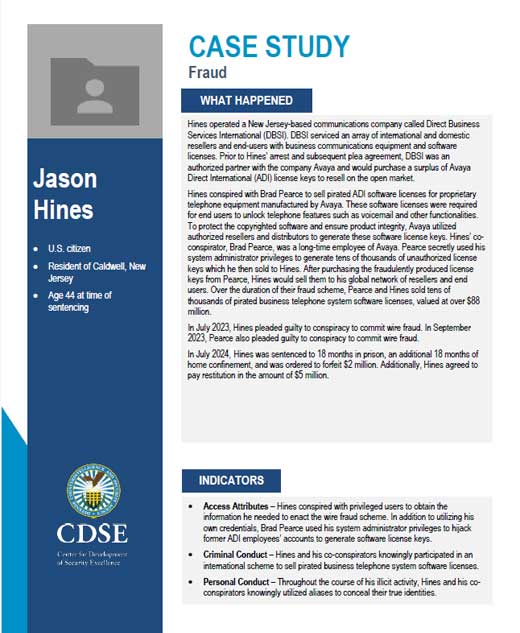
Hines operated a New Jersey-based communications company called Direct Business Services International (DBSI). DBSI serviced an array of international and domestic resellers and end-users with business communications equipment and software licenses. Prior to Hines' arrest and subsequent plea agreement, DBSI was an authorized partner with the company Avaya and would purchase a surplus of Avaya Direct International (ADI) license keys to resell on the open market.
Hines conspired with Brad Pearce to sell pirated ADI software licenses for proprietary telephone equipment manufactured by Avaya. These software licenses were required for end users to unlock telephone features such as voicemail and other functionalities. To protect the copyrighted software and ensure product integrity, Avaya utilized authorized resellers and distributors to generate these software license keys. Hines' co-conspirator, Brad Pearce, was a long-time employee of Avaya. Pearce secretly used his system administrator privileges to generate tens of thousands of unauthorized license keys which he then sold to Hines. After purchasing the fraudulently produced license keys from Pearce, Hines would sell them to his global network of resellers and end users. Over the duration of their fraud scheme, Pearce and Hines sold tens of thousands of pirated business telephone system software licenses, valued at over $88 million.
SOURCE: justice.gov Office of Public Affairs Press Release – October 30, 2026

James Thomas Ashbacher, 37, of Spring Lake, North Carolina, a former U.S. government contractor, was arrested by the FBI on Tuesday for allegedly leaking national defense information by posting the information on a popular social media site, unlawfully retaining other national defense information at his residence, and stealing night vision goggles from the U.S. Army's Special Operations Command.
Ashbacher was charged by an indictment unsealed Tuesday with unlawfully transmitting and retaining national defense information and with theft of government property.
According to the indictment, beginning in or about 2021, the defendant worked as an employee of a private company that provided security and emergency management services at the U.S. Army Special Operations Command facility in Fort Bragg, North Carolina. To perform the required functions of his employment, Ashbacher held a Top Secret security clearance with Sensitive Compartmented Information (SCI) access.
SOURCE: Clearance Jobs by Katie Helbling - October 31, 2026

Continuous Vetting is supposed to make the security clearance process more efficient, but investigators say a lack of communication is creating unnecessary headaches for everyone involved.
Continuous Vetting (CV) was designed to modernize the security clearance process, identifying potential security concerns as they arise rather than waiting years for a periodic reinvestigation. On paper, it makes sense. In practice? Some background investigators are finding themselves spending more time tracking down clearance holders than actually conducting interviews.
A recent ClearanceJobsBlog discussion highlights growing frustration among investigators assigned Reimbursable Suitability / Security Investigations (RSIs), particularly when subjects have no idea why they're being contacted or what Continuous Vetting even means.
SOURCE: Clearance Jobs by Grace Boone - October 22, 2026

It can be tempting to think your social media accounts exist in a world of their own, but your online community can absolutely become a part of your background review when applying for a security clearance. Before you get anxious, one or two dumb posts typically don't endanger your clearance – but patterns of recklessness and posting information that should remain private CAN. These three sentiments can point you in the right direction if you're pursuing clearance and questioning your social media presence.
EXTREMISM MATTERS MORE THAN SPECIFIC POLITICAL OPINIONS
A common misconception surrounding clearances and social media posts is that sharing your political opinions equates to losing your clearance. On the contrary, the U.S. government protects individuals sharing lawful political ideas, but extremist beliefs and endorsement of violence can land you in hot water. Sharing classified information, sometimes even in the form of sharing your work routines and professional habits consistently, is another major disqualifier.
SOURCE: DOD CUI Program

WHO: Taylor Adam Lee, 22, Active Duty (Army)
WHAT: Arrested on charges of attempted transmission of national defense information to a foreign adversary and attempted export of controlled technical data without a license.
WHO: Wenheng Zhao (aka Thomas Zhao), 26 (U.S. Navy)
WHAT: Between August 2021 and at least May 2023, Zhao received at least $14,866 in 14 separate bribe payments from the intelligence officer, who directed Zhao to surreptitious collect and transmit sensitive U.S. military information and offered to pay Zhao bonuses for controlled and classified information.
WHO: Korbein Schultz, 25 (Former U.S. Army Intelligence Analyst)
WHAT: According to court documents, between May 2022 until his arrest in March 2024, Schultz engaged in an ongoing conspiracy to provide dozens of sensitive U.S. military documents — many containing export-controlled tactical and technical information — directly to a foreign national residing in the People's Republic of China.
SOURCE: justice.gov – October 28, 2026
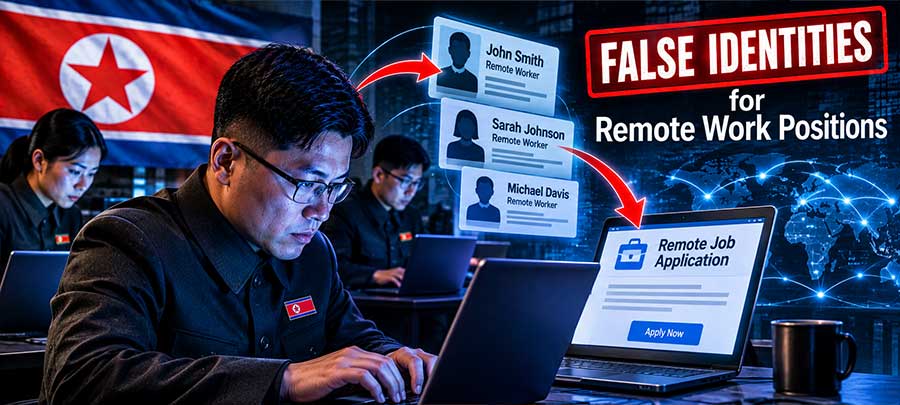
ALEXANDRIA, Va. – A Gainesville man pled guilty today to conspiracy to commit wire fraud relating to a scheme involving fraudulent applications for remote employment using borrowed U.S. identities.
According to court documents from June to August 2025, John Allen Kurrle Jr., 62, was employed by a defense contractor for the U.S. government and held an active Top Secret security clearance with access to secret compartmented information (SCI). During that time, Kurrle participated in a scheme to defraud U.S. companies, including U.S. government contractors, in which he allowed foreign individuals to use his identity to apply for remote work positions and to fraudulently use the identity of a third person to apply for remote positions.
In addition to allowing the use of his identity to apply for remote work positions, Kurrle received laptops shipped by victim companies to his home in Gainesville and enabled remote access from outside the United States.


Let's take a look at the facts—and ask a few important questions:
What does SEAD 3 say?
Security Executive Agent Directive 3 (SEAD 3) establishes reporting requirements for personnel with access to classified information or who hold a sensitive position.
SEAD 3, Section F, paragraph 2(b)(1) requires cleared individuals to report unofficial contact with a known or suspected foreign intelligence agency.
SOURCE: FSO Pros – November 16, 2026

The holiday season brings opportunities to spend time with family and friends, travel, celebrate, and recharge. It can also introduce unique security and safety challenges. Increased travel, online shopping, social gatherings, and busy schedules can create opportunities for criminals, scammers, and other bad actors to take advantage of distractions and reduced vigilance.
The holidays can create distractions and a false sense of security. Busy schedules, crowded stores, travel plans, and social activities often divide our attention and make it easier to overlook warning signs. Criminals, scammers, and other bad actors understand this and frequently increase their activity during the holidays, knowing that distracted people are more likely to make mistakes, let their guard down, or ignore suspicious activity.
As we enter the holiday season, now is a good time to revisit basic safety and security practices that help protect ourselves, our families, our organizations, and the information entrusted to us.
SOURCE: Consumer Credit by Felicity Watts – October 29, 2026

The holidays are a time for celebration, but they are also a busy time for scammers. From fake flash sales and delivery texts to AI-powered voice scams and charity frauds, threats are becoming harder to spot. Avoid holiday scams by staying informed about common tactics, using strong passwords, verifying purchases, and choosing secure payment methods, such as credit cards with fraud protection.